What is coastal style, and how do you keep it from looking like a beach shop?
The look explained from one real room, the souvenir pieces to swap out, paint with codes, and what to buy for each room.
Updated November 16, 2026 · By Daniel Borodin, founder of airender.ai
Short answer
Coastal style is a light, relaxed look built from white, sand and washed sea-glass blues and greens, natural fibers like jute, rattan and linen, light or weathered wood, and easy slipcovered seating. The sea shows up through color and texture, never through anchors, shells or fish, which belong to nautical theme decor. A reliable starting combo: Sherwin-Williams Sea Salt (SW 6204) on the walls, Extra White (SW 7006) on trim, a flat-woven jute rug and linen sheers hung high and wide.
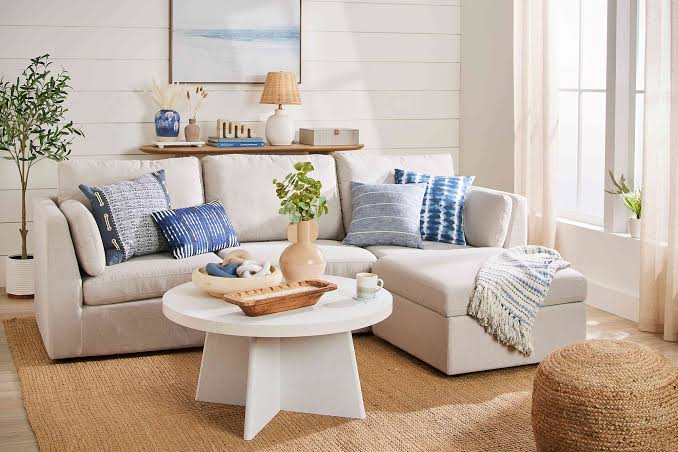
Reading the coastal look off one photo
Look at the room above and try to find anything that literally pictures the ocean. Only the pale seascape on the wall comes close, and it is mostly soft bands of sky and water. No anchor, no starfish, no fish. The room still reads as coastal at a glance, because five things do the work.
Light that comes through
Sheer cream curtains hang open beside a big window, so nothing heavy blocks the glass.
White plus sand as the base
White shiplap, a cream sectional and a white pedestal table, grounded by jute and pale wood.
Natural fiber, used twice
A flat-woven jute rug and a round jute pouf repeat one texture; the rattan lamp shade adds a third weave up high.
Washed, light wood
A pale floor, a light wood ledge and a carved wood tray. Nothing dark or glossy.
One blue thread
Indigo shibori and tie-dye pillows, a striped throw and a blue vase. Blue stays off the walls.
Remove any one of the five and the room drifts toward plain modern. Pile theme objects on top and it drifts toward a gift shop.
Coastal, nautical, Hamptons and coastal grandmother are different looks
Most of what people call tacky beach decor is really nautical decor, or a theme, sold under the coastal label. Design publishers draw clear lines between these looks. Decorilla separates coastal from both nautical and Hamptons, Coral Homes contrasts coastal with Hamptons point by point, and Homedit traces today's coastal style to the Hamptons, where designers chose upscale finishes over nautical props.
| Look | Palette | Signature materials | Motifs | Furniture feel |
|---|---|---|---|---|
| Coastal | Warm neutrals like tan and sand, white, soft pastel blues and pinks | Wicker, rattan, jute, linen, light reclaimed timber | Few or none; texture and color carry it | Relaxed, slipcovered, easy to live on |
| Nautical | Bright, saturated blue walls | Fish nets and maritime props | Anchors, lighthouses, fish, starfish, sand dollars | Theme pieces built around the motif |
| Hamptons | White on white with layers of navy details | Dark, rich woods as accents on floorboards and banisters, shaker cabinetry | Navy in paisley or printed china | Plush upholstered pieces |
| Coastal grandmother | The same ocean palette | The same natural materials | More pattern | Old-fashioned furniture, a fuller, more maximal room |
| Mediterranean coastal | Terracotta tones with the sea colors | Terracotta | Arched windows, ceiling cornices | Carved, architectural detail |
Homedit compares coastal grandmother to grandmillennial: same sea colors, older shapes, more on display. Decorilla also names French coastal (antiques, curved legs, sanded or unfinished wood), New England coastal (cozy seating, whitewashed wood cladding) and Scandinavian coastal (light wood, muted palette). If none of these sounds like you, a quick quiz can find your decor style. If you want the same calm with fewer colors and lower furniture, read about Japandi, the calmer, more minimal cousin of coastal.
The kitsch test: what to take out and what to put in its place
House Digest lists nine mistakes that make a room look like a beach souvenir shop, each with a fix. Decorilla adds two that people rarely notice: carpet and cold artificial light. Here they are as one swap list.
| Reads as souvenir shop | Use instead | Why it works |
|---|---|---|
| Fish wall decor and fish figurines | A seascape painting or an understated sculpture | Suggests the sea instead of spelling it out |
| Bright blue paint on every wall | Sand neutrals such as SW Sand Dune (SW 6086) | Blue stays an accent |
| Busy tropical print pillows | One livelier solid or a sculptural pillow, no mixed patterns | Color without the tourist-shirt print |
| Store-bought shells in bowls | Sculptural shell-shaped bowls or vases | Keeps the shape, loses the souvenir |
| Heavy drapes | Linen, gauze or cotton curtains | Lets the light in |
| Anchors and lighthouses | Driftwood pieces | A beach material, not a beach picture |
| Starfish and sand dollars on shelves | A plant or a bamboo piece | Life and texture, no motif |
| Fish nets draped on walls | Natural textiles or reclaimed wood | Texture without the costume |
| Dark wood furniture | Lighter wood finishes | Works with daylight and recalls driftwood |
| Wall-to-wall carpet | Hard floors with a natural fiber rug | Decorilla warns against carpet |
| Cold, blue-white bulbs | Warmer light | Decorilla flags cold light |
A rule of thumb that covers almost every object in a store: if it depicts the sea, it is probably nautical. If it is made of a beach material or a beach color, it is probably coastal. A jute basket passes, a rope-wrapped anchor does not. David Bromstad, host of HGTV's Beach Flip, put the dated-or-not question simply in a quote House Digest carries: "Beach style and design is timeless, it just must be updated like our wardrobes."
One literal object per room, at most
If you love a piece of coral or an old oar, keep it, but make it the only literal object in the room. Two start a collection, and a collection becomes a theme.
Coastal paint colors with real codes, grouped by job
Decorilla suggests one to three main colors plus one or two accents. In practice: one white for trim and ceiling, one wall color, and blue held back for fabric or a single painted piece. The swatches follow that split: two whites, four sea-glass wall colors, a sand and one deep accent.
| Color | Code | LRV | Best use |
|---|---|---|---|
| Extra White | SW 7006 | 85.9 | Trim, ceilings and shiplap |
| Simply White | BM OC-117 | 89.5 | Trim and ceilings, a softer, creamier white |
| Sea Salt | SW 6204 | 63.2 | Main walls in a bright room |
| Rainwashed | SW 6211 | 59.1 | Bedrooms and baths, a little more color |
| Tradewind | SW 6218 | 60.7 | The bluest of the four sea-glass colors |
| Palladian Blue | BM HC-144 | 60.4 | Benjamin Moore's pick in the same family |
| Sand Dune | SW 6086 | 46.1 | North-facing or inland rooms |
| Naval | SW 6244 | 4.5 | One piece only: a door, an island, a dresser |
Notice what is missing: a saturated, bright blue. Put that on four walls and the room tips into nautical, which is exactly why House Digest swaps it for sand. If your sofa already decides part of the palette, see the wall colors for a white sofa or what color walls go with a blue sofa.
Sample these on two walls
Sea Salt, Rainwashed, Tradewind and Palladian Blue sit between green, gray and blue, and the balance moves with the light. Try a large sample on a sunny wall and a shaded one, morning and evening, before buying gallons.
Materials and fabrics that carry the look
- Jute, seagrass and sisal rugs: the sand-colored base layer. Layer a soft rug on top in a bedroom if bare jute feels rough underfoot.
- Rattan, wicker and cane: lamp shades, chair backs, headboards, baskets. Two or three per room; more starts to look tiki.
- Linen and cotton slipcovers: relaxed upholstery, and a washable cover makes a pale sofa realistic with kids or a dog.
- Light oak, whitewashed and driftwood finishes: tables, shelves and frames, matte rather than glossy.
- Matte ceramics and glass: a white lamp base, a clay vase, a sea-glass bottle. These replace shells on shelves.
- Sheers: gauze, voile or light linen, so daylight fills the room even with the curtains drawn.
Because light is the whole point, sheers deserve real measurements. On an 8 ft (2.4 m) ceiling, Bob Vila suggests mounting the rod about 4 to 6 in (10 to 15 cm) above the window frame and letting the panels touch the floor or stop within 1/2 in (about 1 cm) of it. The Shade Store suggests running the rod 6 to 12 in (15 to 30 cm) past each side of the frame so open curtains clear the glass, and buying sheer panels at 2.5 to 3 times the width they cover, so they look full instead of flat. Puddling 1 to 3 in (2.5 to 7.5 cm) on the floor only suits curtains that stay open.
What to buy for a coastal living room, bedroom, dining room and office
Living room. Pick a rug big enough that at least the front legs of the sofa and chairs sit on it; Ruggable suggests leaving a 12 to 18 in (30 to 46 cm) border of bare floor around an 8x10 ft (about 240x300 cm) rug in a defined seating area. The room in the photo above uses most of these pieces. To see the same look tried on your own sofa and walls, you can redesign your living room with AI.
Bedroom. Castlery suggests a 6x9 ft (about 180x270 cm) rug as a starting point under a queen bed and 8x10 ft as the better size, with the rug reaching 18 to 24 in (46 to 61 cm) beyond the sides and foot of the bed. A king needs 8x10 ft at minimum, and 9x12 ft (about 270x370 cm) fits best. For more bedroom layouts, see our page on AI bedroom design.
Dining room. Ruggable recommends a rug that runs at least 24 in (61 cm) past every side of the table so chairs stay on it when pulled out. The rug size calculator works it out from your table size.
Home office. If your desk chair rolls, skip the big rug; a small runner by the door or bare floor is enough. Put the coastal effort into the desk, the chair and the storage.
Converting a room you already have, in the right order
Most people start by buying and end up with coastal pieces stacked on top of everything they own. Work in this order instead, because each step changes what the next one needs.
- 1
Subtract the theme first
Bag every anchor, sign, shell bowl and fish print, then run the swap table against what is left.
- 2
Change the textiles
Two or three pillows in white, sand and one blue pattern, and sheers instead of heavy drapes.
- 3
Lighten the wood
Slipcover a dark sofa, paint one dark dresser white, or replace only the darkest piece.
- 4
Add one natural fiber layer
A jute or seagrass rug does the most. Keeping a rug you love? Add a woven pouf or basket.
- 5
Hang the sheers high and wide
Above the frame and past the window, so the glass stays clear and the window looks bigger.
- 6
Paint last
Pick the wall color against the new fabrics and wood: Sea Salt or Rainwashed if bright, Sand Dune if dim.
If you want to see the result before step one, try the Coastal preset in airender on a photo of your room, then ask in plain words for changes like "less blue, more sand" or "swap the coffee table for a round white one". The furniture in your design is the exact furniture on your shopping list, so the pieces you like in the picture are the ones you can buy. It is an AI image and not to scale, so check color and size on the listing and measure first. The background is on AI room design with the exact furniture you can buy, and how each real product is picked before the room is drawn covers it step by step.
Inland, north-facing or cold-climate rooms
Coastal works far from the beach, but gray winter light makes sea-glass walls feel chilly. Warm the base toward sand, add a wool throw or wool rug over the jute, and keep blue to pillows and one accent. To carry the look through other rooms without repeating it, see how to make the whole house look cohesive.
Questions people ask
Straight answers to the follow-up questions.
Is coastal decor outdated?
The kitschy version is: anchor pillows, lighthouse lamps and bright blue walls date a room fast. The restrained version, built on sand colors, woven texture and light wood, keeps working. That is Bromstad's point: beach style lasts, but it needs updating like a wardrobe.
What is the difference between coastal and nautical decor?
Nautical decor is about objects that picture the sea: anchors, rope, lighthouses, fish nets, usually with strong blue. Coastal is about how a beach feels: sand and white, soft sea-glass color, jute, rattan and linen. A room can be fully coastal with no sea motif in it at all.
Can I do coastal style if I don't live near the beach?
Yes. The style depends on light, natural fiber and pale wood, none of which need an ocean view. In an inland or cold room, lean on sand tones and wool and keep blue to a few accents.
What colors are considered coastal?
White, sand and tan as the base, with washed blue-greens and soft blues as the main color, and sometimes a pale coral or pink. A deep navy works as one accent piece. Saturated, primary blue on the walls pushes the room toward nautical.
Is coastal grandmother the same as coastal style?
It is an offshoot. Homedit describes it as using the same ocean palette and natural materials but with old-fashioned furniture, more pattern and a fuller, more collected room, close to grandmillennial. Classic coastal is lighter, emptier and more modern.
What is the difference between coastal and Hamptons style?
Hamptons is more polished: white on white with navy details, plush upholstery and dark, rich wood accents such as floorboards and banisters. Coastal is more casual, with warm sand neutrals, rattan and wicker and light raw wood.
See your own room in coastal
Try the Coastal style on a photo of your room and get a shopping list with the same pieces you see in the design.
Related
Sources
- House Digest: 9 Coastal Decor Mistakes That Everyone Makes (And How To Fix Them), Maeve Browne · checked November 16, 2026
- Decorilla: Coastal Interior Design, Tenille Theron · checked November 16, 2026
- Homedit: Coastal Interior Design Characteristics and Ideas, Katie Barton · checked November 16, 2026
- Coral Homes: Coastal vs Hamptons · checked November 16, 2026
- Sherwin-Williams: SW 7006 Extra White · checked November 16, 2026
- Sherwin-Williams: SW 6204 Sea Salt · checked November 16, 2026
- Sherwin-Williams: SW 6211 Rainwashed · checked November 16, 2026
- Sherwin-Williams: SW 6218 Tradewind · checked November 16, 2026
- Sherwin-Williams: SW 6086 Sand Dune · checked November 16, 2026
- Sherwin-Williams: SW 6244 Naval · checked November 16, 2026
- Benjamin Moore: Simply White OC-117 · checked November 16, 2026
- Benjamin Moore: Palladian Blue HC-144 · checked November 16, 2026
- PaintColorHQ: Benjamin Moore Simply White, listed as 2143-70, the same color as OC-117 (hex approximation) · checked November 16, 2026
- PaintColorHQ: Benjamin Moore Palladian Blue HC-144 (hex approximation) · checked November 16, 2026
- Bob Vila: How High to Hang Curtains · checked November 16, 2026
- The Shade Store: How to Measure for Curtains · checked November 16, 2026
- Ruggable: Rug Size Guide · checked November 16, 2026
- Ruggable: Rug Under Dining Table Size Guide · checked November 16, 2026
- Castlery: Rug Placement Under Bed · checked November 16, 2026
Explore more room design guides
Compare AI design tools, estimate furnishing costs, and turn one room photo into a practical plan.
How this page was made
Written by Daniel Borodin, founder of airender.ai. Research and first drafts were AI-assisted; facts about other companies come from their own pages and the sources listed above, checked November 16, 2026. Prices change, so check the store before you buy. Published November 16, 2026, updated November 16, 2026. As an Amazon Associate, airender.ai earns from qualifying purchases.