What is industrial style, and how do you get it at home?
Where the look came from, how to translate loft features for a drywall apartment, which paint does which job, and what to buy for each room.
Updated November 16, 2026 · By Daniel Borodin, founder of airender.ai
Short answer
Industrial style is the look of a factory or warehouse turned into a home: structure left on show (brick, concrete, pipes, steel), black metal mixed with worn wood and leather, a palette from charcoal to warm white, and factory-style lights. You do not need a loft to get it. Start with matte black metal and warm 2,700 K bulbs in a cage or enamel lamp, then add one raw surface such as an Iron Ore (SW 7069) accent wall, and warm everything with leather, wood and wool. The brick can even be pale: Pure White (SW 7005) on brick still reads as industrial.
Where the look comes from: factory floors turned into homes
Industrial style copies buildings that were never meant to be lived in. SoHo in Manhattan is the textbook case. In the 1950s it was a manufacturing district nicknamed Hell's Hundred Acres, and in the 1960s artists started moving into its empty lofts for the tall ceilings and the rows of windows. Those floors were zoned for manufacturing, so many of the artists lived there illegally until 1971, when New York amended its zoning to permit Joint Live-Work Quarters for artists. Two years later the area became the SoHo-Cast Iron Historic District. Most of its cast-iron facades went up between 1840 and 1880, and cast iron is what made those oversized windows and high ceilings possible.
Style guides such as decor8.ai's place the start of the look in the 1960s and 70s, when artists and urban pioneers in New York and London began converting old factories and warehouses into homes and studios. Read every ingredient through that lens. Brick, beams, ducts and pipes are what a converted building still shows, and steel, scarred wood and work lights are what a workshop is furnished with.
Hard loft or soft loft
A hard loft is a former industrial building converted to homes, and many keep their exposed beams, wiring and HVAC ducts instead of hiding them behind a drywall ceiling. A soft loft is a new building made to look like one, with high ceilings, large windows, brickwork and cement ceilings, but none of the history. Most people who want the look live in neither, which is what the next section is for.
Loft features, translated for an ordinary apartment
Each loft feature does a job: rough texture, a dark line against light, a light you can see. You can get the job done without the architecture. Pick two or three rows, not all eight, or the room turns into a stage set.
| Loft feature | Why it reads industrial | In a normal apartment | Rental-safe? |
|---|---|---|---|
| Exposed brick | Rough texture and a sense of age | Peel-and-stick brick panels on one wall, or skip brick and paint one dark accent wall instead | Panels and paint: check your lease first |
| Exposed ducts and pipes | The building's workings left on show | A plug-in pendant with its cord run in plain sight, a pipe-frame shelf, a black conduit-style curtain rod | Yes |
| Steel-framed windows | Thin black lines against daylight | Black curtain rods and rings, a black grid or black-framed mirror, black picture frames | Yes |
| Concrete floor | Cool, gray, hard-wearing | A low-pile gray or overdyed rug, a concrete-look side table or planter | Yes |
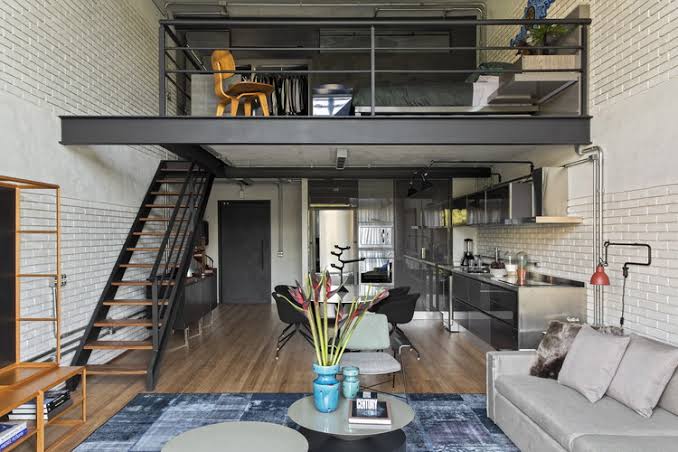
| Factory lighting | Bare bulbs, metal shades, visible cords | A cage or enamel pendant, or a plug-in swing-arm wall sconce like the red one in the photo above | Yes, if it plugs in |
| High ceilings | Volume and vertical space | Curtains hung close to the ceiling, low sofas and beds that leave the wall above empty | Mostly; rods need small screw holes |
| Salvaged furniture | Pieces with a working past | One metal-and-wood piece, a leather chair, a single real vintage find | Yes |
| Cast-iron radiator | Heavy old metal | If you already have one, repaint it rather than replace it; if not, skip this row | Ask the landlord before painting |
Brick does not need to be red
The room at the top of this page has white-painted brick, a pale gray sofa and a blue rug, and it still reads as industrial. The black steel stair and mezzanine, the bare pipes and the red swing-arm lamp carry the style. Dark lines and visible work lights matter more than the color of the wall.
Industrial has flavors: which one is yours
These looks share black metal but split on walls, wood and mood.
| Flavor | Walls | Metal | Wood | Signature piece | Feels like |
|---|---|---|---|---|---|
| Vintage or classic industrial | Red or dark brick, charcoal | Raw or blackened steel, cast iron, a little rust | Dark, scarred, reclaimed | A factory-cart coffee table, metal bistro chairs | A workshop with a sofa in it |
| Modern industrial | Smooth charcoal or gray paint, some concrete | Matte black, clean welds | Smooth dark oak or walnut, used sparingly | Black steel and glass shelving, a low leather sofa | A tidy city apartment after dark |
| Rustic industrial | Warm white or wood planks | Black iron, galvanized steel | Chunky, rough, farmhouse | A trestle table on a metal base, barn-style pendants | A converted barn |
| Soft or Scandi industrial | White or pale gray, painted brick | Thin black lines only | Pale to mid oak | A light upholstered sofa beside one black steel piece | The photo above: bright and calm |
| Mid-century modern (for contrast) | Warm white with mustard or teal accents | Brass, little black | Walnut, teak | A tapered-leg sofa, molded plywood chairs | A 1950s and 60s living room |
The two styles mix more than the table suggests: the mezzanine in the photo above holds a molded plywood chair, a mid-century shape, next to black steel. If walnut and tapered legs pull at you more than steel does, take the decor style quiz or read what makes a room mid-century modern. If the pale row is your favorite, the Scandinavian style guide covers the light half of that mix.
The industrial paint palette, with a job for each color
| Job | Color | LRV | Note |
|---|---|---|---|
| Painted brick, ceilings | Pure White SW 7005 | 83.96 | Close to the white brick in the photo above; bright without going stark |
| Main walls in a dim room | Repose Gray SW 7015 | 58.22 | Light enough to keep the room bright, gray enough to sit next to black metal |
| Main walls, moody version | Gauntlet Gray SW 7019 | 17.43 | Deep gray that is dark without turning into black |
| Accent wall or built-ins | Peppercorn SW 7674 | 9.68 | Charcoal for one wall behind a sofa or bed |
| Accent wall or kitchen island | Iron Ore SW 7069 | 5.55 | Near-black; rated for interior and exterior use |
| Doors, window frames, radiators | Tricorn Black SW 6258 | 2.85 | The darkest of the set; on frames it looks like painted steel |
| One warm rust accent | Cavern Clay SW 7701 | 19.94 | Terracotta on a single door, cabinet or bookcase back |
| One deep rust accent | Roycroft Copper Red SW 2839 | 7.03 | Oxblood for a front door or a run of lower cabinets |
| Optional green accent | Pewter Green SW 6208 | 11.83 | A muted green that sits well with black metal and brown leather |
Prefer Benjamin Moore? For the same jobs, use Chantilly Lace OC-65 (LRV 90.04) on brick and ceilings, Kendall Charcoal HC-166 (LRV 14.61) for moody walls, and Wrought Iron 2124-10 (LRV 8.17), a black Benjamin Moore calls soft and malleable in character, on doors and accents. Benjamin Moore's pages give no hex codes, so judge these from a physical sample.
Materials: hard pieces, softened on purpose
- Matte black steel and iron for frames, legs, rods and handles. Matte, not chrome: shiny metal reads as modern rather than factory. RentCafe's renter advice points the same way: brass, copper, wrought iron or stainless steel instead of gold tones and shiny finishes.
- One wood tone, rough or reclaimed, mid to dark. Two competing woods next to black metal start to look busy, so if a second wood stays, follow the rules for mixing different wood tones.
- Brown or cognac leather on at least one seat. Its warmth is what stops the black from feeling harsh. Already own one? Here are wall colors for a brown leather sofa.
- Concrete or stone on one surface, such as a side table, lamp base, planter or counter. One is texture; four is a parking garage.
- Wool, canvas, jute and washed linen for the soft layer. Hunker's industrial apartment examples pair brick with lighter furnishings and soften the rooms with low furniture, pillows and throws, potted plants and an area rug.
- Glass and wire for lighting: clear globes, cage shades, enamel domes.
If your main seat is black rather than brown, the balance shifts: you need more warmth in the walls and wood, which is covered in what color walls go with a black sofa. A March 2026 guide from ArchitectureCourses.org warns against all-gray schemes for this reason. Gray walls, gray concrete and black metal with nothing warm beside them feel like an office.
Key industrial pieces for each room
Living room. This room has its own guide with 10 industrial living room ideas with a fully priced room, so here is only the core: one leather seat, one metal-and-wood table, one work light, and a rug that softens the floor.
Bedroom. This is the room that needs the least steel and the most softness. Let the bed frame and the wall lights carry the style, then layer the bedding heavily.
Dining room. Industrial suits dining best of all, because a heavy table and metal chairs are what the style is built from. Keep the chairs comfortable with seat pads if they are all metal.
Home office. Steel-and-wood desks are easy to find at every price, which makes the office the cheapest room to do in this style. For a full budget plan, see furnishing a home office for under $1,000.
Getting the look in the room you already have
- 1
Fix the light first
Swap bulbs to warm, about 2,700 K (sold as "soft white"), in a filament style, and add one cage or enamel lamp. Daylight bulbs, around 5,000 to 6,500 K, turn gray and black cold.
- 2
Switch hardware and rods to matte black
Curtain rods, cabinet pulls, picture frames and the lamp you already own. It is cheap, fast and fully reversible.
- 3
Choose one raw surface
A brick panel wall, one painted accent wall, or a concrete-look piece. One, not four.
- 4
Add one wood-and-metal piece and one leather piece
A coffee table or desk on a steel frame, plus a leather chair or sofa. Together they cover most of the look.
- 5
Soften it
A wool or jute rug, canvas or linen at the windows, a big plant. This is the step people skip, and it is why their rooms feel cold.
- 6
Edit the cords and clutter
A visible cord works when you chose it. Tidy every other one, and close up shelves that only hold mess.
To see this on your own room before you buy anything, airender has Industrial as one of its style presets. It picks real products first, then designs your room around them, so the furniture in your design is the exact furniture on your shopping list. You can also ask in words, for example "keep my sofa, add black metal shelving and a leather chair". The details are in AI room design with the exact furniture you can buy and how the products are picked before the picture is made.
Before you order
It is an AI image and not to scale, so check color and size on each listing and measure your room first.
Mistakes that make industrial feel cold or fake
All gray, nothing warm
Gray walls, gray rug, gray sofa. Fix: add one warm anchor, such as leather, mid-tone wood or a rust accent.
Theme props everywhere
Fake street signs, decorative gears, faux-rust clocks. Fix: one real vintage piece beats five props.
Black on everything
Black walls, black sofa, black shelves and three other metal finishes. Fix: keep black to lines and frames plus one wall at most, and stick to one or two metal finishes.
Open shelving on every wall
It looks like storage, not a home. Fix: one open unit, closed cabinets everywhere else.
Blue-white daylight bulbs
They flatten concrete and gray paint. Fix: warm bulbs at about 2,700 K, from more than one lamp.
Only metal to sit on
Metal chairs, metal stools, a metal bench. Fix: one upholstered seat and cushions on the rest.
The first four match ArchitectureCourses.org's 2026 list of common industrial mistakes; the bulb and seating cards are design judgment.
Questions people ask
Straight answers to the follow-up questions.
Can I do industrial style without exposed brick?
Yes. Brick is one texture among several, and black metal lines, work lights and leather do more of the work. A dark painted wall in a color like Peppercorn or Iron Ore, or a concrete-look table, gives the raw surface without brick at all.
Is industrial style still in style?
It rests on materials (steel, wood, leather) rather than one decade's trend colors, so the pieces age well and mix easily into Scandinavian and modern rooms. The version that looks dated is the prop-heavy one with fake signs and gears.
What is the difference between industrial and modern industrial?
Classic industrial leans on age: rough brick, rust, reclaimed wood, salvaged pieces. Modern industrial keeps the black metal and dark palette but uses smooth walls, clean welds and less wood, so it looks newer and tidier.
What colors go with industrial style?
Charcoals and near-blacks for accents and frames, a warm white or light gray for the main walls, and one rust or terracotta color for warmth. Brown leather and mid-tone wood count as colors too: they are the warm half of the palette.
Can renters do industrial style?
Most of it, yes. Lighting, black rods and hardware, rugs, furniture and leaning shelves need no permission. Paint, wall panels and anything wired in depend on your lease, so ask before you start.
Does industrial style work in a small apartment?
It works well if you keep the walls light and the dark parts thin. Choose furniture on legs so the floor shows, use one dark accent instead of a dark room, and pick slim black frames over chunky metal pieces.
See your room as an industrial loft
Pick the Industrial preset on a photo of your room and get a design built from real furniture you can buy.
Related
Sources
- Wikipedia: SoHo, Manhattan · checked November 16, 2026
- Wikipedia: Loft · checked November 16, 2026
- decor8.ai: Industrial style · checked November 16, 2026
- Wikipedia: Color temperature · checked November 16, 2026
- Sherwin-Williams: SW 7005 Pure White · checked November 16, 2026
- Sherwin-Williams: SW 7015 Repose Gray · checked November 16, 2026
- Sherwin-Williams: SW 7019 Gauntlet Gray · checked November 16, 2026
- Sherwin-Williams: SW 7674 Peppercorn · checked November 16, 2026
- Sherwin-Williams: SW 7069 Iron Ore · checked November 16, 2026
- Sherwin-Williams: SW 6258 Tricorn Black · checked November 16, 2026
- Sherwin-Williams: SW 7701 Cavern Clay · checked November 16, 2026
- Sherwin-Williams: SW 2839 Roycroft Copper Red · checked November 16, 2026
- Sherwin-Williams: SW 6208 Pewter Green · checked November 16, 2026
- Benjamin Moore: Chantilly Lace OC-65 · checked November 16, 2026
- Benjamin Moore: Kendall Charcoal HC-166 · checked November 16, 2026
- Benjamin Moore: Wrought Iron 2124-10 · checked November 16, 2026
- ArchitectureCourses.org: Industrial interior design (March 1, 2026) · checked November 16, 2026
- RentCafe: Revolutionize Your Apartment with These Industrial Style Tips (June 19, 2020) · checked November 16, 2026
- Hunker: Get the Look of an Industrial Style Apartment (June 25, 2020) · checked November 16, 2026
Explore more room design guides
Compare AI design tools, estimate furnishing costs, and turn one room photo into a practical plan.
How this page was made
Written by Daniel Borodin, founder of airender.ai. Research and first drafts were AI-assisted; facts about other companies come from their own pages and the sources listed above, checked November 16, 2026. Prices change, so check the store before you buy. Published November 16, 2026, updated November 16, 2026. As an Amazon Associate, airender.ai earns from qualifying purchases.