How accurate is AI interior design? Will your room really look like the picture?
Accurate about some things, guessing about others. Here is which is which, shown on one real redesign. Checked November 16, 2026.
Updated November 16, 2026 · By Daniel Borodin, founder of airender.ai
Short answer
Accurate about style, palette and mood; not reliable about size, light or anything wired or built. An image model measures nothing, so scale is a guess, the lighting is invented, and doorways or fixtures can drift. Products are the one area where accuracy depends on the tool: most draw invented furniture, while airender picks real products first, so the furniture in its design is the furniture on its list. Your room can end up looking like the picture if you measure, sample paint and read listed dimensions before you buy.
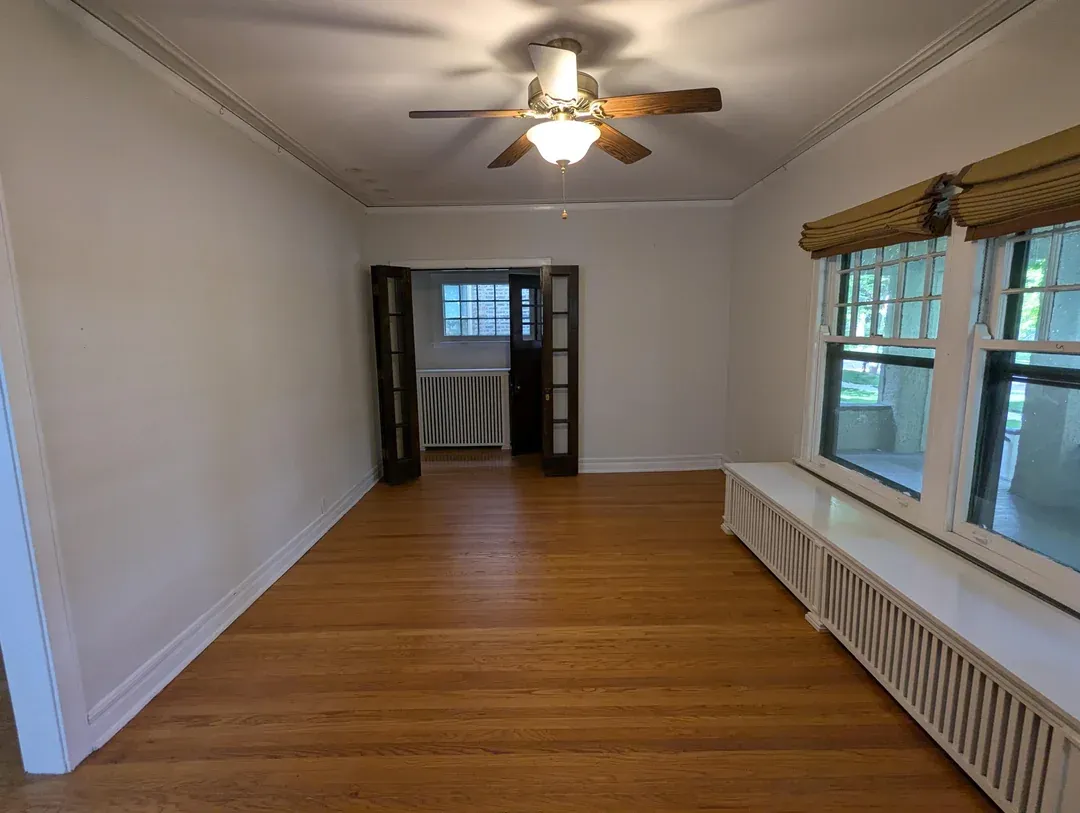 Before
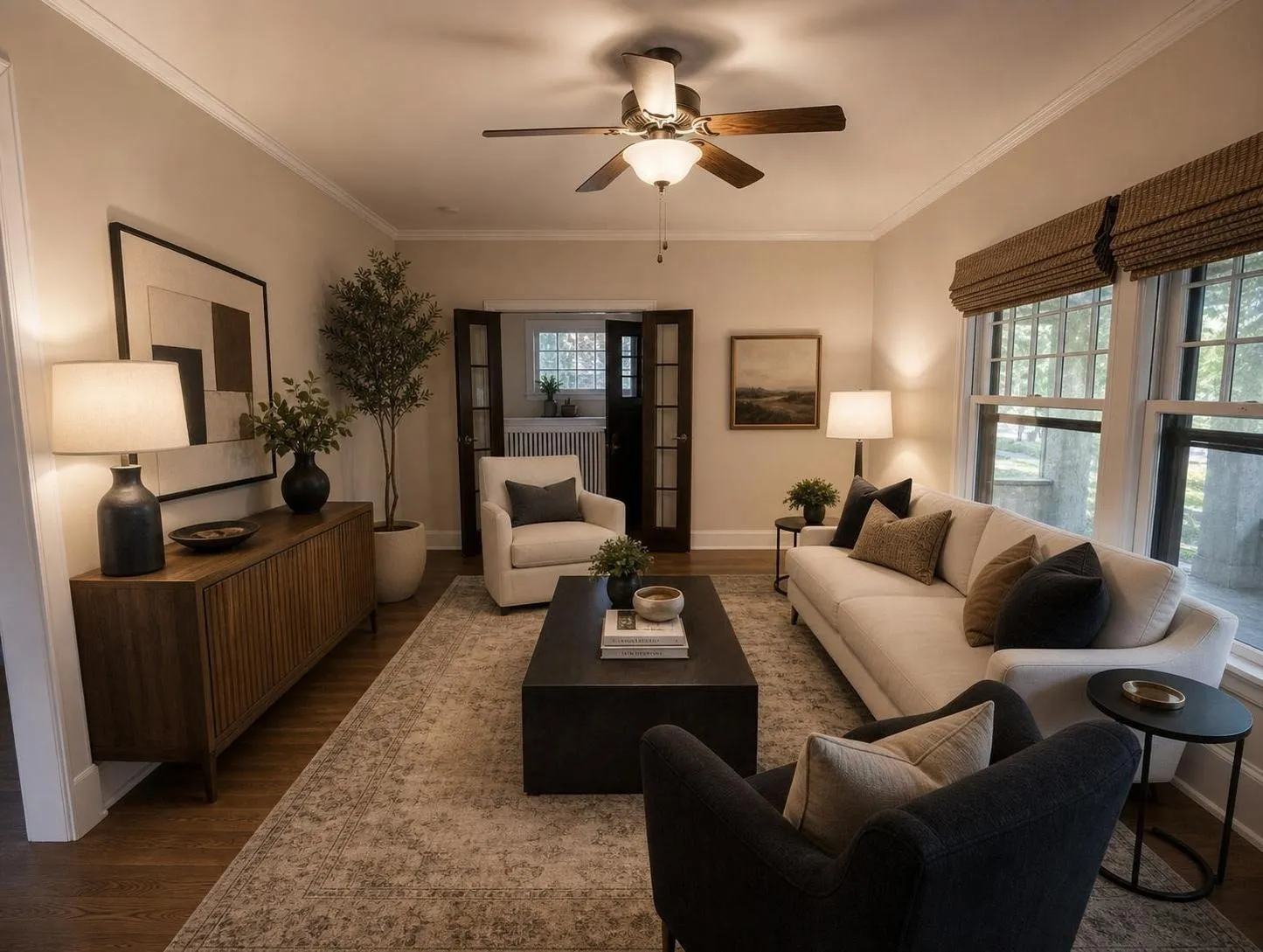 After, with airender
Accuracy scorecard: nine things a redesign shows you
| Aspect | Reliable | Unreliable | How you check it |
|---|---|---|---|
| Style and mood | Yes, the strongest part of every tool | Rarely off | Would you want to sit in that room tonight? |
| Color palette | The color family and contrast | Exact shades, which follow the image's lighting | Paint chips and fabric swatches in your own light |
| Room shell (windows, doors, walls, molding) | Big features in a straight-on photo | Doorways, paneling and window size can move or vanish | Spot-the-difference against your before photo |
| Scale and proportions | A rough sense of how full the room is | Pieces drawn larger or smaller to fill a gap | Measure the wall and floor, then read listed dimensions |
| Lighting | A flattering mood | Time of day and lamp light are made up | Look at the room at the hours you use it |
| Paint on your wall | Whether a color family suits the room | Undertone and depth, which shift with window direction, bulbs and sheen | Physical samples on two walls, morning and evening |
| Products | Depends on the tool (see below) | Invented pieces in most tools | Each listing's photos and dimensions |
| Layout and clearances | Where big pieces could go | Walkways, door swing and chair pull-out are not checked | Tape the footprint on the floor |
| Fixtures and wiring | Ideas for new lighting | Fixtures get swapped or added with no thought for boxes and outlets | Treat it as a question for an electrician |
The cause behind almost every right-hand cell is the same: an image model draws a plausible picture and measures nothing. Business of Home put it plainly in 2023: "AI doesn't really know the dimensions of the room you're asking it to re-imagine." Imersian, which sells room visualizers to furniture retailers, wrote in November 2026: "Size is estimated by the image model, not measured."
One redesign, checked line by line
The pair at the top of this page is a fair test case, misses included. One note on the input: it is a phone photo of an empty room in daylight, with nothing for the AI to restyle, so every piece in the result was added. A lived-in room gives any AI more to misread, and an empty one shows most clearly what it changes on its own.
| Feature | Before | After | Verdict |
|---|---|---|---|
| Camera angle and framing | Standing height, looking down the length of the room | Same | Held |
| Ceiling fan and crown molding | Five-blade fan with a glass bowl light, white crown molding | Same fan, same molding | Held |
| French doors and back room | Dark French doors open to a back room with a radiator and a window | Same doors, same back room | Held |
| Windows | Two windows on the right wall with divided upper sashes | Same two windows | Held |
| Window shades | Olive fabric roman shades | Woven wood roman shades | Changed: decor you can buy |
| Radiator cover under the windows | Long white cover along the right wall | Not visible; the sofa sits where it was | Hidden: it is still in the real room, so the sofa has to clear it |
| Floor | Honey oak | Darker brown wood | Changed: that is refinishing, not shopping |
| Walls | Cool light gray | Warm beige | Changed, or just relit: sample paint before you decide |
| Light | Daylight through the windows | Evening, every lamp on | Invented: the image picked the hour |
| Furniture and decor | None | Sofa, two armchairs, coffee table, sideboard, rug, two lamps, a tree and art | Added: decor you can buy |
Read that way, the shell held and the empty room filled, which is what a redesign is for. Three rows are not shopping, though. The darker floor would mean refinishing, the warmer walls may be paint or may only be lamplight, and the radiator cover that vanished behind the sofa still takes up depth in the real room. The picture flags none of that. Sort every change into decor you can buy and work someone has to do.
Do this with your own redesign
Put your before photo next to the result and list every fixed feature: windows, doors, outlets, vents, radiators, paneling, ceiling lights. Anything moved, removed or added is something the picture cannot promise. The fewer surprises you want, the better your photo needs to be; the best photo for AI room design covers where to stand and which lens to use.
Business of Home saw the same pattern in other tools. It found in 2025 that Wayfair's Muse had improved but was "still a little finicky, prone to expanding windows and shifting corners." A Houzz discussion titled "The Hallucination Trap" warns that after a small request, "your existing windows suddenly move, your structural walls warp, and your actual architecture disappears."
Scale: why no AI image is a measured plan
The image model sizes each product "based on what seems plausible in the picture," Imersian writes. "It may be close. It may also shrink a sofa to fill a gap." So a sofa that sits neatly under a window in the image can be noticeably longer on the listing.
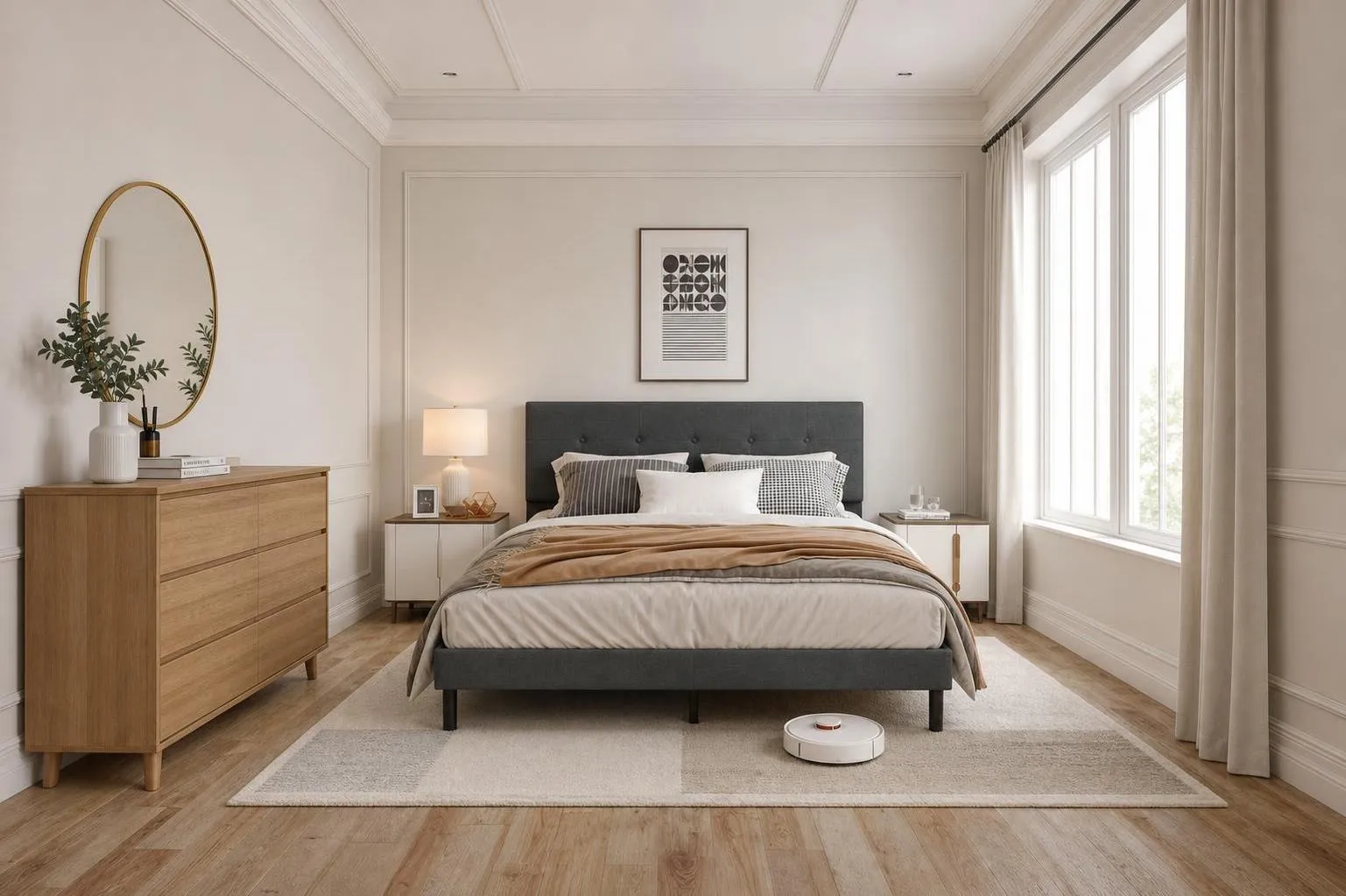
Look at the bedroom above and try to read sizes off it. A full bed is 54 inches wide (137 cm) and a queen 60 (152 cm); at this angle they would look almost the same. Your phone adds a second distortion: wide-angle lenses stretch the edges of a room and shrink whatever is far away. 3D catalog tools work differently. IKEA Kreativ turns your photos into "a single wide-angle 3D image" and shows IKEA furniture "in real, adjusted proportions," but only for IKEA's own catalog. Our airender vs IKEA Kreativ comparison shows what that difference means when you plan a real room.
Not a measured plan
An airender redesign is a visual concept and not to scale. Entering your room size (width x length) guides it, and a bright, straight-on photo helps, but measure before you buy anything big.
The 10-minute test before you buy anything
You need your before photo, a tape measure and a roll of painter's tape.
- 1
Compare fixed features
Check windows, doors, outlets, vents and radiators against your before photo. Circle anything that moved, vanished or appeared.
- 2
Measure walls, floor and doorways
Write down each wall that will hold furniture, the floor zone you plan to use, the ceiling height and every doorway a big piece must pass. Note inches and cm so you can read any listing.
- 3
Rough proportion check
On a wall facing the camera, estimate what share of it a piece covers. On a 144 inch (366 cm) wall, a sofa spanning about half suggests roughly 72 inches (183 cm). Compare that with the listed width. This only works for pieces flat against the wall you measured.
- 4
Tape the footprint
Mark the listed width and depth of each big piece on the floor and live with it for a day.
- 5
Check clearances
Compare the space left around each piece with the table below.
- 6
Size the rug and the TV with numbers
At least the front legs of your seating should sit on the rug, per Ruggable's size guide. The rug size calculator and TV size calculator beat eyeballing the image.
- 7
Read listed dimensions, not the picture
Width, depth and height on every listing. For sofas, compare seat height and depth with what you sit on now.
- 8
Test paint with real samples
Never choose paint from the image. Match the AI wall color to real paint to get three chips, then see the next section.
| Clearance | Guideline (in) | Guideline (cm) |
|---|---|---|
| Walkway around large furniture | 30 to 48 | 76 to 122 |
| Walkway in a small space | At least 24 | At least 61 |
| Sofa to coffee table | 14 to 18 | 36 to 46 |
| Around a bed | At least 24 | At least 61 |
| Dining table to wall or other furniture | At least 36 | At least 91 |
Door swing
A dresser drawn beside a door may stop it opening fully. Measure the arc.
Radiators and vents
Images happily draw furniture over them. Keep heat and airflow clear.
Outlets
Every lamp in the picture needs a socket nearby. Mark yours first.
Ceiling height
Tall shelves and trees must clear the ceiling and any slope.
Light and paint on your actual walls
AI tools often relight the room, and your screen shifts color again on top. Treat colors in the image as a direction. A Benjamin Moore course on light and paint explains why real walls move too:
- Light in north-facing rooms "tends to be diffuse and cool," so lighter shades can look muted.
- East-facing rooms get warm morning light, but colors "cool off as the sun moves higher."
- The color temperature of your bulbs "may cause a color shift" in a paint's undertone.
- Sheen changes how a color reads, so test the finish you plan to buy.
Sample before you buy gallons
Put samples on two different walls and check them morning and evening. Peel-and-stick sheets such as Samplize, in 9 x 15 in (23 x 38 cm) or 15 x 18 in (38 x 46 cm), can be moved around the room as the light changes.
Products: the one row where the tool decides
A general image generator invents the furniture, so the sofa in the picture is not for sale. Tools that draw first and match afterwards give you real products that resemble the drawing, and matching can miss badly: Business of Home reported that Wayfair's earlier Decorify tool would sometimes confuse an armchair for an ottoman and a chandelier for a decorative birdcage.
airender reverses the order. It picks a real product for each piece, draws the room from those products, and lists the same pieces with buy links and a room total; the method is set out in how airender picks real furniture, and the result is AI room design with the exact furniture you can buy. It is an AI image, so check color and size on each listing before you order. Why color and detail can read differently in any image is covered in why AI room designs look different from the products.
| Tool type | Keeps your room | Scale | Furniture in the picture | Best for |
|---|---|---|---|---|
| Chat AIs and image generators (ChatGPT, Gemini) | Can lose the room's shape over a long chat | Not measured | Invented; named products may not exist | Brainstorming styles |
| Photo redesign apps that draw, then match | Works from your photo; fixed features can drift | Not to scale | Invented, with real lookalikes listed | Seeing a style in your room |
| airender (products first) | Works from your photo; fixed features can drift | Not to scale | The real products on your list | Seeing a style in your room and buying it |
| 3D catalog placement (IKEA Kreativ) | Built from your photos as a 3D image | Real, adjusted proportions | Real IKEA products only | Checking fit when buying IKEA |
| Measured floor plan or a designer | Yes, from real measurements | To scale | Whatever you specify | Tight rooms, built-ins, renovations |
Business of Home's 2025 test found that chatbots can "slowly lose the architectural envelope of a room as the conversation progresses" and concluded: "All of these chatbots will get things wrong." If you plan with ChatGPT anyway, how to use ChatGPT to redesign your room shows how to keep it anchored.
Accurate enough for what?
- Good enough: choosing a style for a room you already have, settling a palette, seeing which pieces a room lacks, comparing several looks before spending anything.
- Not good enough: built-ins and renovations, tight rooms where a few inches decide what fits, moving lights or outlets, and matching an exact paint color.
If most of your project sits in the first group, a redesign earns its place. If it sits in the second, you need a tape measure, samples and possibly a person. Weighing that against the cost is the subject of is AI interior design worth it.
Questions people ask
Straight answers to the follow-up questions.
Is AI interior design to scale?
No. Image models estimate how big things look instead of measuring, so a sofa can be drawn smaller or larger than the real product. Only 3D catalog tools like IKEA Kreativ claim real proportions, and only for their own products.
Why did the AI move my window or remove a door?
The model redraws the whole image, so fixed features can drift, especially doorways, paneling and window size. A straight-on, level photo reduces it. Compare the redesign with your before photo and ignore any change you cannot actually make.
Will the paint color look the same on my wall as in the AI picture?
Probably not. The image invents its own lighting, your screen shifts color, and real paint changes with window direction, bulbs and sheen. Pick a color family from the picture, then test real samples on two walls at different times of day. A paint maker's own visualizer is closer, since every color it shows has a real code; the options are compared in [apps to see paint colors on a photo of your room](/app-to-see-paint-colors-on-a-photo-of-my-room).
Will the furniture in an AI design fit my room?
Not automatically. Tape each piece's listed width and depth on the floor, and leave 30 to 48 inches (76 to 122 cm) for walkways and 14 to 18 inches (36 to 46 cm) between sofa and coffee table. Check doorways too, since the piece has to get in.
Can I trust ChatGPT's room redesign?
For ideas, yes. For planning, be careful: Business of Home found that chatbots can lose a room's shape as a conversation goes on and sometimes recommend products that do not exist. Open every product link and check it against your measurements.
See your room redesigned, then measure with confidence
Upload one photo for a redesign and a shopping list with buy links and a room total, then run the 10-minute test before you buy.
Related
- How do you take the best photo of your room for an AI redesign?
- Why does the AI design look different from the products in the shopping list?
- Is AI interior design worth it, or should you hire a designer?
- Can you actually buy the furniture you see in an AI room design?
- Rug size calculator
- Ai vs interior designer
Sources
- Houzz: The "Hallucination" Trap (AI renderings) · checked November 16, 2026
- Business of Home: 3 big problems AI design apps are racing to solve (May 3, 2023) · checked November 16, 2026
- Business of Home: Wayfair's new tool shows AI's strengths and limitations (Mar 28, 2025) · checked November 16, 2026
- Business of Home: The AI interior design race has a surprising frontrunner (Aug 6, 2025) · checked November 16, 2026
- Imersian: AI image generation looks incredible, but it doesn't actually help you furnish a room (Nov 4, 2026) · checked November 16, 2026
- IKEA: How does IKEA Kreativ work? · checked November 16, 2026
- Benjamin Moore / BNP Media: The Science of Visible Light and Its Impact on Paint Specification · checked November 16, 2026
- Samplize: How it works · checked November 16, 2026
- Southern Home and Hospitality: Where to put furniture in a room · checked November 16, 2026
- Ruggable: Rug size guide · checked November 16, 2026
Explore more room design guides
Compare AI design tools, estimate furnishing costs, and turn one room photo into a practical plan.
How this page was made
Written by Daniel Borodin, founder of airender.ai. Research and first drafts were AI-assisted; facts about other companies come from their own pages and the sources listed above, checked November 16, 2026. Prices change, so check the store before you buy. Published November 16, 2026, updated November 16, 2026.